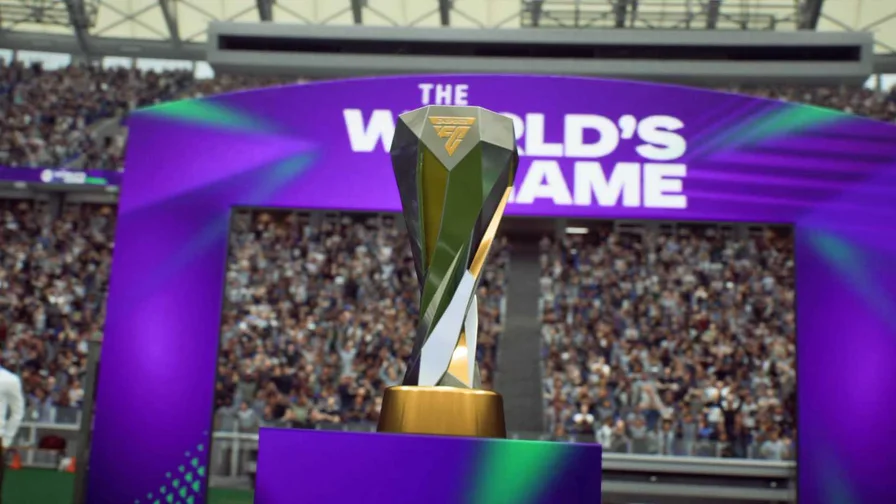
In early June 2026, EA Sports FC 26 released a free “World Tournament” update built around 48 national teams, then offered a deep discount before the World Cup. Yet this was not a recreation of the old FIFA World Cup editions: the familiar national-team journey and trophy-lifting sequence were absent.
The game carrying the official FIFA World Cup name appeared instead on Netflix Games. FIFA World Cup: Launch Edition offered a lighter mobile experience in which players could choose a national team and complete their own tournament story.
The contrast was striking. Electronic Arts, football gaming’s most established publisher, no longer owned the FIFA World Cup name. FIFA’s own licensed game was no longer a large annual console release.
Behind that split lies a history involving far more than game design: rights to tournaments, leagues and players; official recognition; and the construction of esports systems. Looking back from this World Cup reveals the growth of EA’s flagship series, the return of eFootball and the rise of unconventional competitors such as Rocket League and Football Manager.
The FIFA–EA era
One institutional starting point for football esports came at the 2000 WCG Challenge in Yongin, South Korea. FIFA 2000 appeared alongside Age of Empires II, StarCraft and Quake III, placing football gaming inside esports at the moment the concept was becoming formalized.
The following year, Chinese players Yan Bo and Lin Xiaogang won the FIFA doubles event. In subsequent WCG editions, German twins dominated the discipline, taking eight games across 11 tournaments. Their success reflected the relationship between European football clubs and Germany’s ESL system, as more traditional clubs began signing FIFA professionals as an entry into esports.
In 2004, FIFA and EA Sports launched the FIFA Interactive World Cup in Zurich. Only nine countries took part, but its institutional meaning was significant: FIFA had recognized a video-game competition as an official World Cup, placing football’s digital counterpart inside a governance structure parallel to the physical sport.
Participation and commercialization grew steadily. More than two million unique players entered qualifying in 2016. The competition became the FIFA eWorld Cup in 2018, signaling a transition from interactive entertainment toward a professional esports category.
The partnership, dating back to FIFA International Soccer—often called FIFA ‘94—ended in 2022. FIFA 23 was the final jointly branded release, and the 2023 eWorld Cup was the last official tournament played on the FIFA series. Licensing fees were the immediate cause, but the paths each side took afterward created the more important structural change.
EA renamed the game EA Sports FC and rebuilt its circuit as FC Pro. The FC Pro World Championship joined the Esports World Cup in 2025 and returned in 2026 with a record $1.5 million prize pool and 36 players competing in Paris from July 22 to 26.
Rather than create an entirely isolated flagship competition, EA embedded FC Pro within EWC’s multi-title platform. FC 26 also sold more than ten million copies within two weeks. EA may have lost FIFA’s official status, but it retained the player habits it had cultivated over three decades.
FIFA’s multi-partner approach
FIFAe took over the official competition in 2024. It retained the national-team structure and console and mobile divisions, but no longer depended on one publisher. FIFA instead adopted a “multi-partner ecosystem” spanning eFootball, Football Manager and Rocket League—a game in which rocket-powered cars replace footballers.
Rocket League may be the strongest of those partners. Its World Cup 2026 event allowed players to represent countries, earn points through online goals and unlock national stickers and games. It dispensed with real players and pitches, but isolated the World Cup elements most easily translated into a game: national identity, goals, rankings and collective pride.
Rocket League also has a mature independent circuit. Founded by Psyonix in 2016 and now run by Epic Games, RLCS awarded $9.7 million in 2025, up 45% year on year. The 2026 Boston Major set a record peak of 624,000 viewers. After Karmine Corp won a Paris Major in overtime, French President Emmanuel Macron publicly congratulated the team—an unusual level of recognition for football-game esports.
Football Manager represents a different expansion of the definition. Players never directly control a footballer; they win through tactics, transfers and dressing-room management. FIFAe first included it in 2024, when 40 competitors representing 19 countries played for $100,000. After a pause caused by the game’s delayed release, it returned in 2026 as the FIFAe Club World Cup, open to professional, semi-professional and amateur supporter clubs. Its inclusion shows how broadly FIFA now interprets “esports.”
eFootball returns, and markets diverge
eFootball, formerly Pro Evolution Soccer, has also gained new momentum. The 2023 Asian Games used EA Sports FC Online, a free-to-play product operated separately in China, South Korea, Vietnam and Thailand. At the 2026 Aichi–Nagoya Asian Games, FC Online was replaced by eFootball, returning after eight years with separate PC and mobile events.
Competitive integrity, broadcast viability and regional relevance informed the selection, but Japan’s home-market context matters too. eFootball is a Konami product with a long history in Japan and parts of Asia. Its audience is more mobile-heavy and concentrated in Japan and Southeast Asia. Asian Games inclusion, alongside its FIFAe role, gives it a significant new layer of official recognition.
The products now map onto different regions. FC Pro is strongest in Europe and North America, supported by EA’s licensing across the major European leagues and Champions League. eFootball draws on emotional ties to Winning Eleven and PES across Asian markets.
EA also maintains FC Online in Asia. South Korea has the most developed ecosystem: Nexon’s FSL had a KRW 2 billion annual prize pool in 2026 and included organizations such as T1, KT Rolster and DRX. Infrastructure originally built around StarCraft and League of Legends has transferred effectively to a football MMO.
The resulting landscape is fragmented. EA owns the largest products, two competition systems and the strongest established user base, but not the FIFA World Cup name. eFootball has regained official visibility through FIFAe, the Asian Games and national-team events. Rocket League carries the most shareable parts of World Cup activation through country rankings and a mature circuit. FIFA’s own Launch Edition has returned as a lighter mobile product.
No single game now absorbs the World Cup surge. Rights, platforms, tournament systems and communities divide the attention. Football esports, which began as one relatively coherent path around the turn of the century, now follows several disconnected branches belonging to different publishers and regions.
The World Cup remains the traffic peak every football game wants to approach. In esports, however, football is no longer played in only one way.