Esports has no shortage of ambition or ideas. What it often lacks is a shared method for defining problems, comparing credible choices, and committing to a course of action.
Esports knows how to move quickly. That is not necessarily the same as knowing where to move. When viewership declines, the immediate answer might be a new broadcast format. When a team loses sponsors, the answer might be another commercial hire. When a tournament struggles to sell tickets, the answer might be more influencers, more advertising, or a different venue. Some of these responses may be correct. The problem is that the industry often moves from a visible symptom to a preferred solution without spending enough time defining what has actually gone wrong. This is where the 1-3-1 approach can be useful. The framework is simple:
- One problem
- Three possible solutions
- One recommendation
It is commonly used to encourage employees to bring solutions rather than merely escalate problems. However, its value extends beyond internal management. Applied properly, it could improve how esports teams, publishers, tournament operators, sponsors, and governing bodies make strategic decisions. The framework will not solve the industry’s problems by itself. What it can do is make the assumptions, alternatives, and trade-offs behind a decision much clearer.
The most difficult “one” is the problem
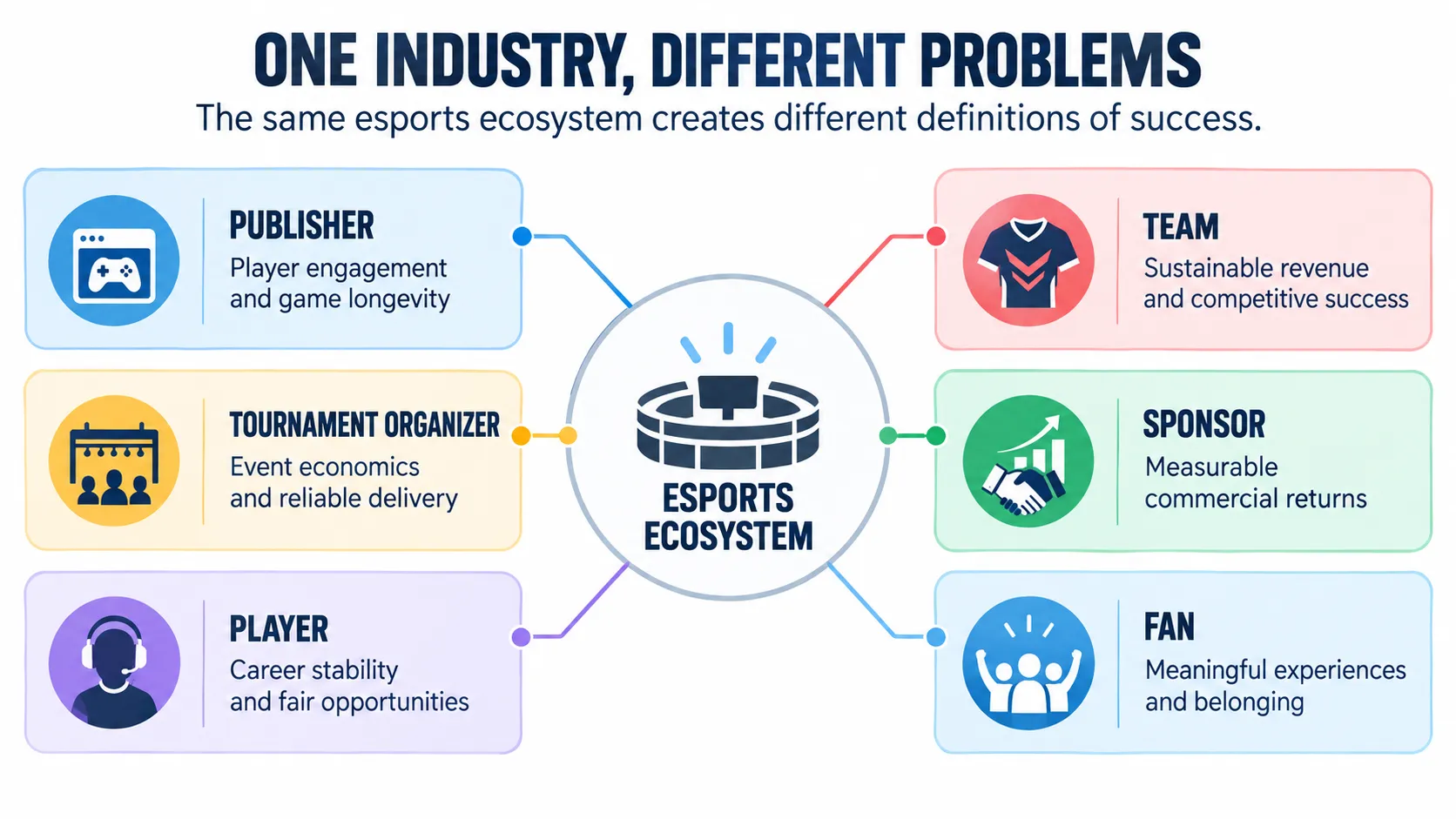
The first step sounds easy: identify one problem. In esports, it may be the hardest part. The industry is not a single organization with one owner, one budget, or one definition of success. A publisher may view esports as a player-engagement and marketing tool. A professional team needs a sustainable competitive business. A tournament operator needs events that can cover their costs. Sponsors want measurable commercial results, while players need stable careers and meaningful competitive opportunities. Each stakeholder can therefore look at the same situation and see a different problem.
Consider a league with declining audience figures. The publisher may believe the game needs new content. Teams may argue that the competition format is weakening fan loyalty. Broadcasters may point to scheduling or distribution. Sponsors may say the audience is still present but insufficiently understood. Fans may simply feel that the competition no longer gives them a reason to care. If every party defines the problem differently, their solutions will naturally pull in different directions. The first contribution of 1-3-1 is therefore not the generation of ideas. It is the discipline of agreeing on the specific problem those ideas are supposed to solve.
Defining the industry-level problem
No single statement can represent every game, region, and competitive ecosystem. Nevertheless, one issue connects many of the industry’s current pressures:
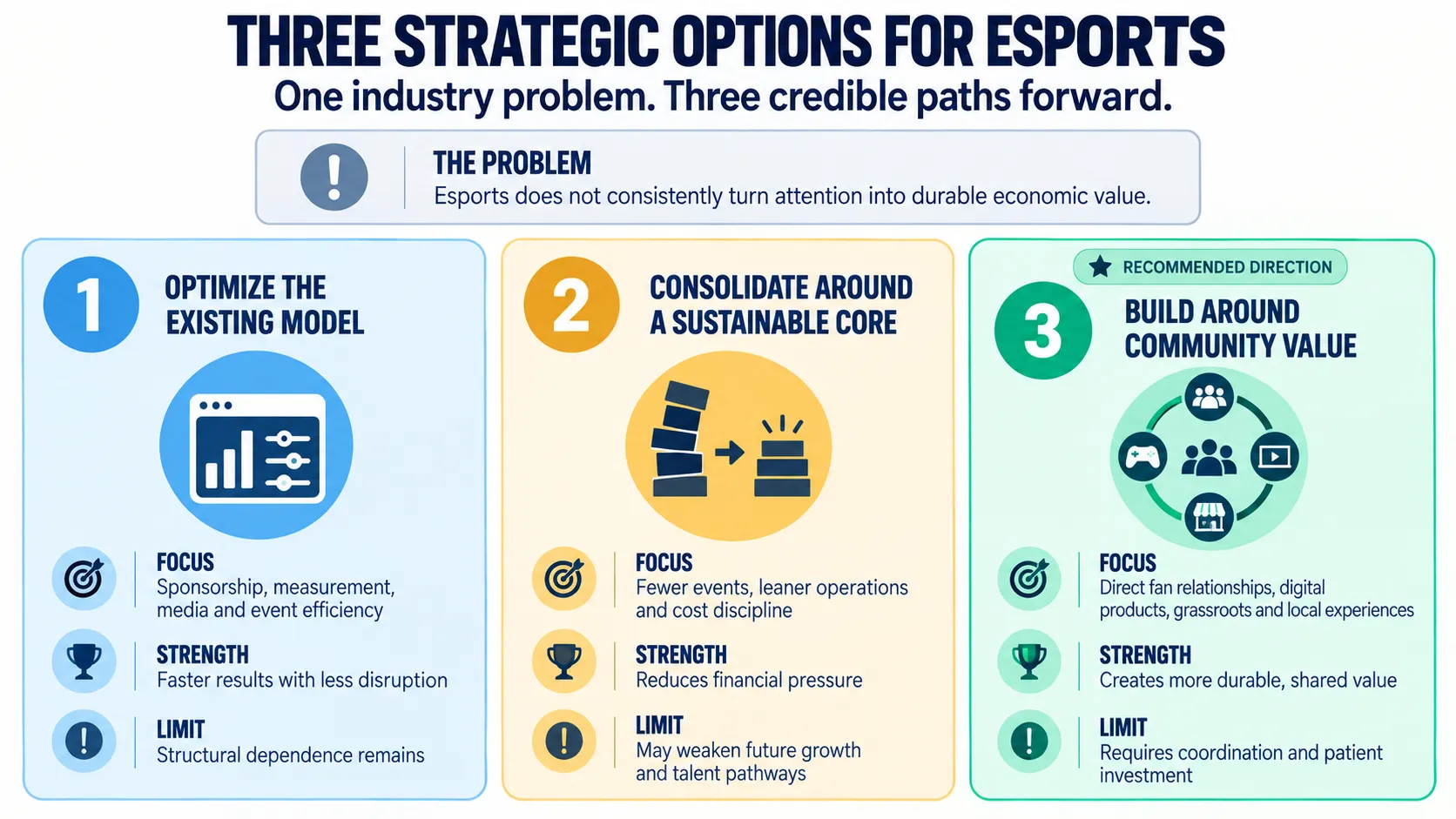
Esports has demonstrated that it can generate attention, but it has not consistently converted and distributed that attention into durable economic value.
This is more useful than saying that esports has a “profitability problem.” The industry continues to produce passionate communities, major events, competitive narratives, and globally recognized players. The underlying product is not simply failing to attract interest. The harder question is how that interest becomes repeatable revenue and how the resulting value is shared between the publishers, teams, event operators, players, creators, and communities responsible for producing it. Recent industry developments reveal different attempts to close this gap.
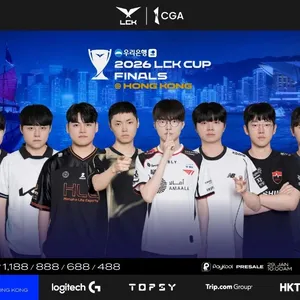
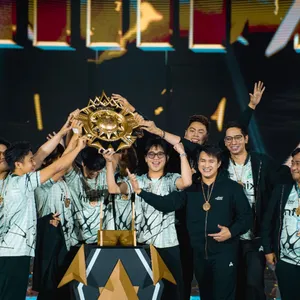
The LCK’s decision to take an official competition outside South Korea was not only an international expansion exercise. It was also an attempt to turn an established online audience into ticket sales, merchandise demand, and regional sponsorship opportunities. In Indonesia, organizations such as RRQ have moved beyond conventional team sponsorship by developing digital services, talent management, community activities, and physical venues. The team is no longer treated as the entire business. It becomes the center of a wider relationship with its audience. These examples point toward the same underlying question: how can esports convert cultural relevance and community attention into value that lasts beyond one tournament, one sponsor, or one successful competitive season? Once that problem is defined, the industry can examine three broad options.
Three strategic options for esports: optimize the existing model, consolidate, or build around community value
Option one: Optimize the existing commercial model
The first option is to improve what esports already does. Teams can provide sponsors with better audience data, clearer campaign measurement, and more valuable content. Tournament operators can improve ticketing, broadcasting, hospitality, and event efficiency. Leagues can develop more sophisticated regional sponsorship packages and media products. This option is attractive because it causes the least disruption. It works within existing structures and could produce faster commercial results.
There is still considerable room for improvement. Esports has sometimes sold broad concepts such as “access to young audiences” without sufficiently demonstrating what a partnership achieved. Better measurement, stronger account management, and more creative activation can make the existing model more effective. However, optimization has limits. A better sponsorship proposal does not remove an organization’s dependence on sponsorship. A more efficient event does not automatically create year-round demand. Improved audience reporting can help justify a commercial investment, but it cannot guarantee that the underlying value will be shared sustainably across the ecosystem. Optimization could make the current model perform better without changing its fundamental weaknesses.
Option two: Contract around a sustainable core
The second option is consolidation. This can mean smaller leagues, fewer events, leaner organizations, more disciplined player salaries, shared production resources, or a narrower focus on games and markets with demonstrated demand. Contraction is often treated as evidence of failure. That is not always fair. Industries that expand rapidly frequently need to correct unrealistic assumptions and remove activities that are not producing sufficient value. A smaller ecosystem can be healthier than a larger one built on unsustainable spending. Financial discipline can protect organizations from repeatedly chasing scale without a credible route to revenue.
The risk is that contraction can solve the cost problem while weakening the product. Fewer tournaments may reduce operating expenses, but they also create fewer stories for fans to follow and fewer opportunities for players to develop. Cutting community programs may improve the next financial quarter while weakening the future audience. Reducing investment without identifying what creates long-term value can turn discipline into managed decline. Consolidation may be necessary in parts of the industry, but cost reduction alone is not a growth strategy.
Option three: Build around community value
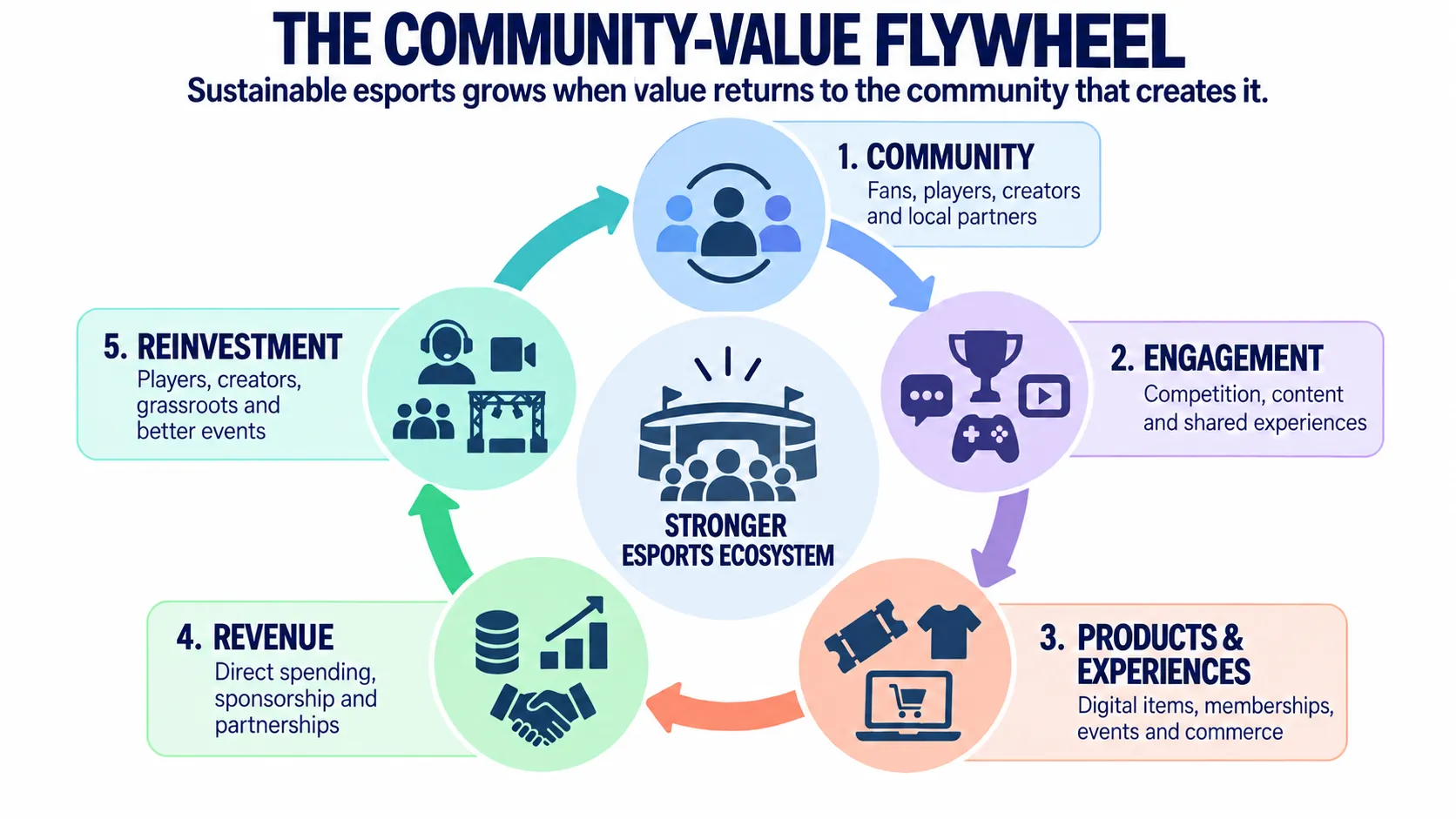
The third option is to redesign the commercial model around the relationship between an esports property and its community. This does not simply mean selling more merchandise. It means treating fans, creators, amateur players, local communities, and in-game users as active participants in the ecosystem rather than an audience that appears only when a sponsor needs exposure. Possible components include:
- Digital products and in-game esports integrations
- Membership and loyalty programs
- Creator-led content and distribution
- Grassroots and amateur competition
- Local watch parties and fan events
- Ticketing, hospitality, and tourism partnerships
- Community commerce and gaming services
- Revenue-sharing structures connecting publishers, teams, and players
This model can also give esports a stronger connection to place. PressTheGame’s reporting on Guangdong’s provincial esports development shows how competition can connect with city identity, local culture, tourism, restaurants, universities, and public infrastructure. Similarly, the VCT CN touring model places competition, publishing, host cities, clubs, players, commercial spaces, and fans within one coordinated system. The event is not treated as an isolated broadcast product. It becomes a platform through which different stakeholders create value together. This is the most complex option. It requires patient investment, closer coordination, and difficult conversations about control and revenue distribution. It may also produce different answers in different markets. Its advantage is that it addresses the structural problem rather than only its symptoms.
The recommendation: Make community value the core business
Of the three options, I would recommend the third: build esports around community value and direct fan relationships. This does not mean rejecting sponsorship or ignoring financial discipline. Sponsorship will remain important, and some consolidation may be necessary. But these should support the strategic direction rather than become the direction themselves.
A community-first model asks a different question. Instead of asking, “How do we sell this audience to another sponsor?” it asks, “What do people in this community value, and what can we build with them that they will return to?” That shift matters. A sponsor is more likely to invest in an ecosystem with demonstrable fan behavior, trusted distribution, and multiple forms of engagement. A team with direct community relationships has more to offer than logo placement. A tournament connected to tourism, retail, creators, and local culture can generate value beyond broadcast impressions. Most importantly, it gives the ecosystem a reason to invest in supporters between major events.
What 1-3-1 could look like for different stakeholders
The same discipline can be applied at an organizational level. A team facing unstable revenue could define one problem, compare deeper sponsorship specialization, operational contraction, and direct-to-fan business development, and then recommend one route based on its capabilities. A tournament operator with weak attendance could compare lower ticket prices, a different venue strategy, and a broader festival-style experience rather than assuming that more advertising is automatically the answer. A publisher concerned about its competitive talent pipeline could assess additional professional slots, regional academy competition, and publisher-supported grassroots infrastructure before committing resources. A sponsor dissatisfied with a partnership could compare withdrawing, renegotiating its media assets, and building a longer-term community program. In every case, the framework forces the decision-maker to do three things:
- Separate the problem from its symptoms.
- Consider alternatives that involve genuine trade-offs.
- Take responsibility for a recommendation.
This is especially important in esports, where decisions are often presented as unavoidable responses to “the market.” Markets create pressure, but people still make choices about how to respond.
The framework also has limits
The 1-3-1 method should not become bureaucratic theatre. Three weak options do not create a good decision. If one proposal is clearly preferred from the beginning and the other two exist only to make it look stronger, the exercise has failed. The framework should also not be used to delay urgent escalation. Match-fixing concerns, harassment, safeguarding incidents, cybersecurity threats, and player-welfare emergencies should be reported immediately. Nobody should remain silent because they have not prepared three solutions. At an industry level, the method also requires clarity about decision-making authority. A team can recommend changes to a league, but it may not have the power to implement them. A tournament operator can propose a new commercial model, but the publisher may control the relevant rights. Good problem-solving therefore requires more than ideas. It requires shared information, clear ownership, and an understanding of who can make the final decision.
Better decisions before bigger ambitions
Esports frequently discusses its future through the language of scale: bigger audiences, bigger events, more investment, more markets, and greater mainstream recognition. Scale is valuable only when the system beneath it works. The 1-3-1 framework offers the industry a useful pause between identifying a challenge and announcing its next initiative. It asks stakeholders to define what is wrong, acknowledge that more than one response is possible, and explain why their chosen direction is the right one. Applied to the industry’s economic challenge, the conclusion is straightforward:
- One problem: Esports does not consistently convert and distribute its attention into durable economic value.
- Three options: Optimize the existing model, contract around a sustainable core, or rebuild around community value.
- One recommendation: Make community value and direct fan relationships the center of the business.
The hardest part is not producing three options. It is agreeing on the one problem the industry is genuinely trying to solve.