The decline of Overwatch seemed inevitable. After established esports powerhouses such as IG and WE withdrew, another team—MY—announced that some of its players would try other titles. The wave of team formation at the game’s peak had turned into departures and pivots, leaving many observers wondering what had happened.
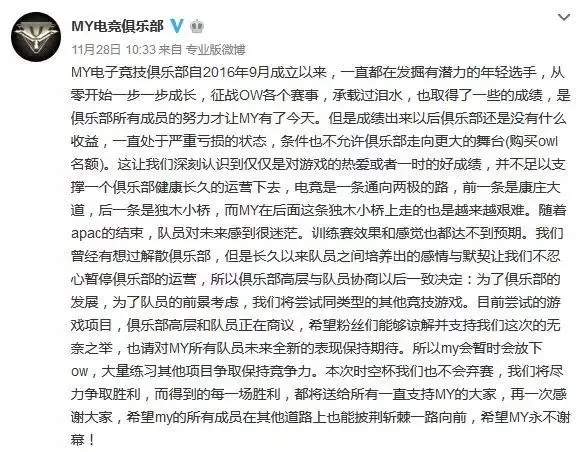
MY’s November 2017 announcement said players would shift their focus while the details were still being discussed.
Only days earlier, MY had said on its official Weibo account that players would focus on other games, with the details still under discussion. As one of China’s strongest teams, MY’s apparent “exit” prompted an outpouring of regret. But “exit” needed qualification. Reporting by Esports Ecology found that MY was not leaving Overwatch: it would continue to compete in events for which it remained eligible. Overwatch was still the team’s core. Under business pressure, only a small number of players would try streaming other titles.
“The bottom line is that it has become very hard for a team to survive. There is so little room to generate revenue that we had to consider a partial transition,” MY team lead Hu Hao told the reporter with a sigh. After more than a year of travelling with the roster and collecting one honor after another, he was reluctant to accept that the team had reached this point.
From M&A Due Diligence to Team Management
Five years after graduating, Hu Hao, who had been working in corporate investment and M&A due diligence, made a major decision the previous year: he would leave a well-paid job.
“The work was fulfilling and professional, but it left me almost no personal time. I still wanted to go out and try to build something of my own,” Hu told Esports Ecology. Esports, then attracting considerable investor attention, entered his field of view, and a friend introduced him to the industry.
Hu eventually met the investors behind MY. They offered him a relatively open environment in which to build. “Unlike my old job, where I spent my time dealing with cold data and rushing through reports for projects of every size, I felt like a cog on an assembly line. When work got busy, there was no time to think. Things are demanding at MY too, but this feels more like starting a business than simply having a job.”
At the time, Overwatch was rapidly becoming the main attraction in internet cafés. Some media reports and third-party estimates even put it ahead of the long-dominant League of Legends. Its popularity was comparable to the PUBG craze then underway.
Forming an Overwatch team was on the minds of many people in the industry. That included small teams like MY as well as traditional powerhouses like IG and WE. “What Blizzard makes is bound to be a classic” was almost an article of faith.
With that conviction, MY threw itself into Overwatch. League of Legends was a giant standing in its path, but the team believed Overwatch, backed by the Blizzard name, could claim a place in esports.
MY initially planned to use Overwatch as its entry point into esports, build a following and gain experience, then expand into League of Legends, Honor of Kings and other titles.
MY was prepared to absorb early losses as long as the team could produce results. Its core management began planning the future around its own strengths and settled on a model built on developing players in-house.
Given Overwatch’s popularity at the time, the strategy was reasonable, even cautious. For a small team without a long history, results were the route to recognition. Once it had an audience, the club could begin turning that attention into revenue. If Overwatch continued to grow like other esports titles, MY seemed well placed to succeed in China’s online market.
Success Came Out of Nowhere, Then Left Too Soon
To put its youth-development approach into practice, MY established a head-coach-led system. The coach was given authority over training, management and competition to ensure that tactics were carried out. “The coach has always been at the core of our team. Almost all our players were recruited by the coach from the ranked ladder and developed in-house. We did not pay high transfer fees to take them from other teams.”
MY’s coach, Wang Xingrui, had previously been a professional player with Royal Club in League of Legends and had also coached the game. His experience with established professional teams prepared him to manage MY’s young roster.
Wang delivered. Although he had come from League of Legends, he understood Overwatch well. MY’s off-meta, ground-based Reinhardt strategy dominated the domestic scene.
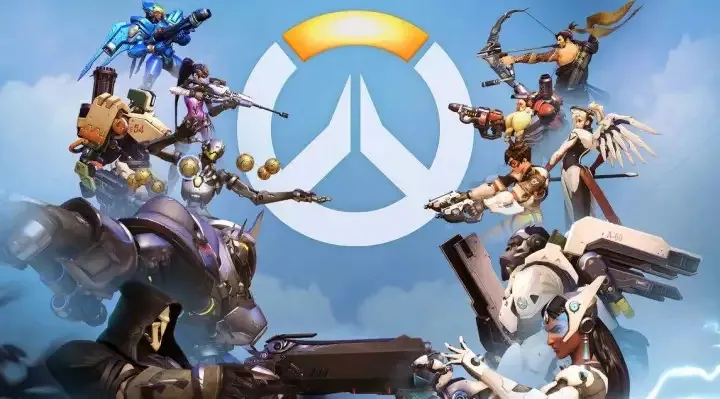
The source article paired its discussion of MY’s Overwatch results with game artwork.
MY’s business plan also called for it to keep none of the tournament prize money. Nearly all of it went to players, coaches and other staff. The team expected to earn a return later through commercial sponsorships and streaming-platform contracts.
Once its core structure was in place, MY entered what the article called its “harvest period.” It repeatedly won domestic competitions. Internationally, it performed well against Korean powerhouse LH at the Seoul Cup. MY narrowly lost, but won broad praise in China and abroad. At APAC, it beat a strong Australian team to reach the semifinals, establishing itself as one of China’s top teams.
Under the original plan, MY would begin diversifying its business after becoming a top team. In practice, that did not work out. Given Overwatch’s popularity, neither sponsorship offers nor the streaming environment could support the club’s continued operation.
After an initial burst of popularity, Overwatch entered a downturn far earlier and more sharply than anyone had expected.
As Overwatch esports was getting started, Blizzard offered relatively little support to small clubs and had not built a system that could sustain the different parts of the industry. Put simply, Blizzard had not designed an esports model in which everyone could make a living.
There were few official or licensed competitions. In a year, teams had little beyond the Overwatch Premier Series (OWPS), Overwatch Team Story (OTS) and the Time Cup. Tournaments run by streaming platforms also faced pressure from official events.
The league did not share revenue with clubs. During a season that stretched for months, clubs were tied to the league and unable to enter other events. They competed for a small prize pool and received no share of sponsorship revenue or broadcast-rights income.
Blizzard Entertainment’s community-tournament licensing terms made third-party events difficult to sustain as the game’s popularity fell, limiting clubs’ ability to grow through that ecosystem. The shortage of events first reduced exposure and prize money. Lower viewership on streaming platforms then pushed clubs into prolonged periods of operating at a loss.
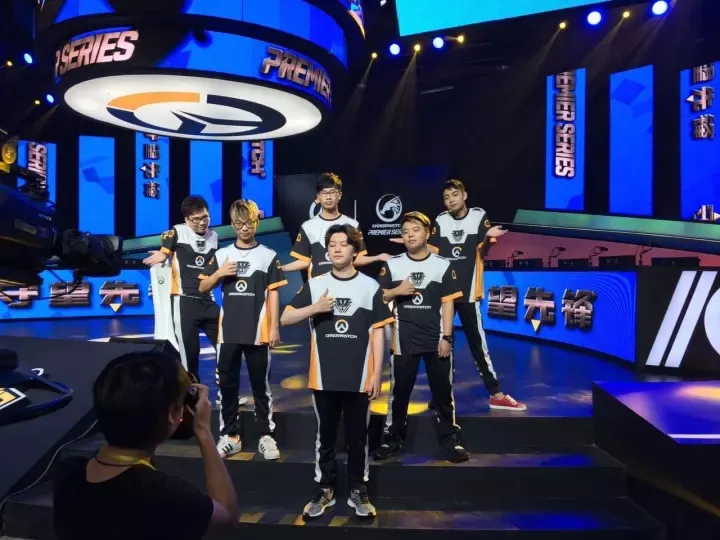
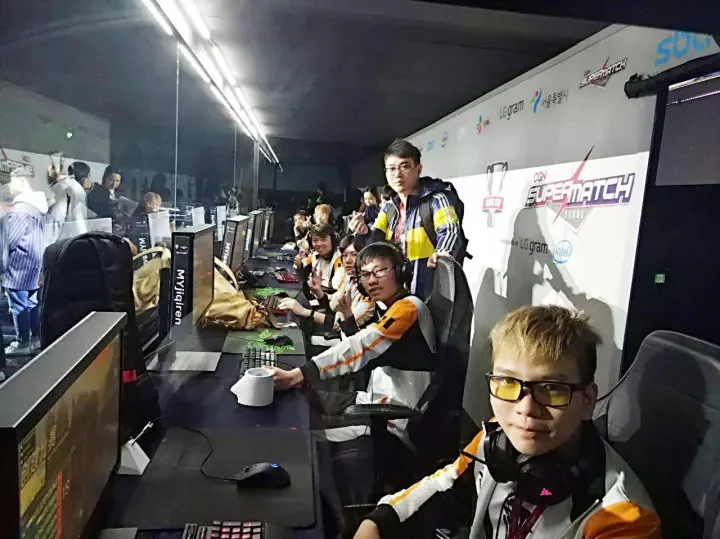
The original article used this stage photograph while discussing the Overwatch League’s high entry costs.
The Future Looked Bright, but the Model Was Unsustainable
“Even after winning a championship, you can feel lost and see no good way forward,” Hu said. MY had become one of China’s strongest teams, but it still faced the same painful question.
Blizzard appeared to recognize the crisis and introduced a series of measures. A few days before MY published its “exit” notice, Blizzard announced its 2018 competition plan: professional leagues in China, Korea and the Pacific would become Contenders series. The announcement said the change would give players more opportunities to challenge themselves and be discovered by scouts from the Overwatch League.
But the plan did not fundamentally change the business model. Its ambitious outline did not explain how clubs would make money the following year. Instead, some of the best players could be recruited into the Overwatch League. The announcement did little for smaller clubs like MY.
The Overwatch League was beyond the reach of a club like MY. A reported US$20 million entry fee made it a game for large investors. MY was not alone in “exiting”: IG, WE and NGA also faced the same outcome. This collective trend was not something one team could reverse.
Even if a club could pay the US$20 million entry fee, the room for commercial activity inside Blizzard’s esports system remained uncertain. The game’s popularity was already declining.
“So, whether for basic business reasons or because our players could not get onto a bigger platform, we chose a partial transition,” Hu said. MY was not disbanding its Overwatch team. Some players would move to more popular games to stream, while the team continued to compete in every Overwatch event for which it qualified. “We still need to discuss the details with the players and the owner, but Overwatch remains the core of the team’s operations.” Despite the announcement on Weibo, the team continued training as usual.