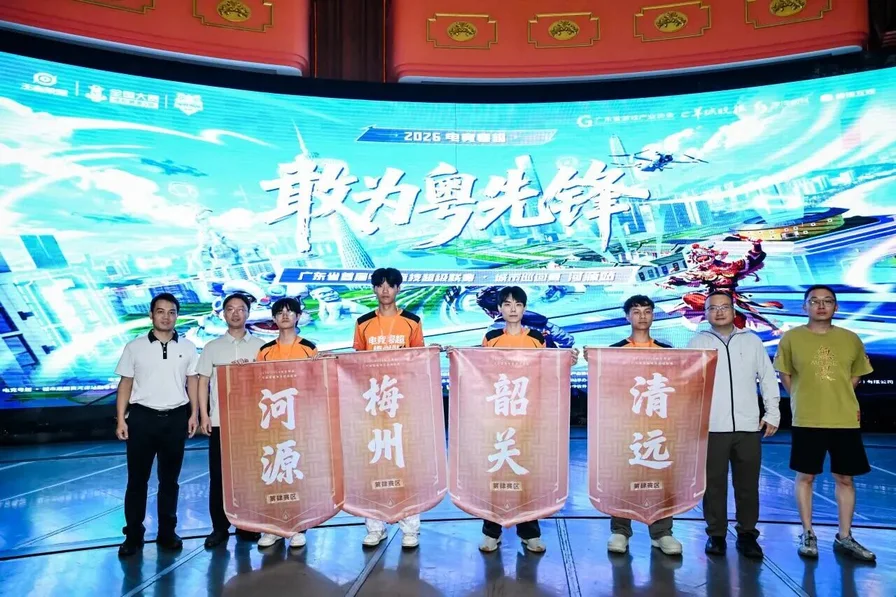
On June 7, 2026, the online stage of the Guangdong Esports Super League’s five-city home tour concluded. Zhaoqing, Zhuhai, Chaozhou, Meizhou and Yunfu each hosted a regional stage, with qualifying teams from all 21 prefecture-level cities competing for points.
The timing was significant. One year had passed since Guangdong introduced a provincial policy package for games and esports. In 2025, it was difficult to say what such a broad framework would change. A year later, the effects are becoming visible in both city culture and industrial coordination.
From isolated competition to a provincial system
At the 2025 China International Cultural Industries Fair, Guangdong released two sets of measures: one for high-quality development of online games and another for esports. Together they created a provincial framework spanning two closely related industries.
The package was not limited to subsidies. It addressed event approvals, venue support, security, transport and tourism coordination. Previously, a cross-city league might need separate procedures with police, fire, culture, tourism and transport authorities, each city applying different standards. The new framework promotes a single coordinated process, venue guidelines and joint support from provincial and local departments.
Tencent Interactive Entertainment vice president Yu Ruichao described the benefit directly: major events are expensive and operationally demanding, while smaller competitions tend to be fragmented. Treating the event system as its own policy area makes systematic planning possible.
The deeper objective is to replace city-to-city duplication with specialization. Guangzhou and Shenzhen form the two core hubs. Guangzhou continues to strengthen event operations and club development, adding 18 local support measures at the end of 2025. Shenzhen uses its technology and digital-economy base to pursue international events.
Other Pearl River Delta cities can absorb different parts of the industry. Dongguan’s electronics base supports esports hardware; Foshan combines manufacturing and tourism with physical event experiences; Zhuhai uses Hengqin’s position to explore cross-border events and training. The intended model is “two hubs, multiple nodes, province-wide coordination.”
When a city truly owns a team
Esports has often struggled to create the regional culture found in football. A tournament may arrive, operate for several days and leave without building a lasting relationship between city and audience.
The Guangdong league, the province’s first non-professional mass-participation esports competition, was designed to address that weakness.
Rather than dividing teams only by geography, it organizes the 21 cities into five Lingnan cultural regions: Guangfu, Greater Bay Area, Chaoshan, Hakka and western Guangdong. Players must provide local household registration, social-insurance records or a student card. External recruits and account boosting are excluded so residents genuinely represent their city.
At the Foshan stop, a Shunde tourism representative presented the local team with its city flag. The squad finished runner-up and temporarily led the VALORANT standings. At Meizhou, Shaoguan ML remained focused on earning points at home despite an earlier defeat.
An official rap battle released in June turned the 21 cities’ identities into lyrics: Guangzhou claimed the authority of a thousand-year commercial capital, while Foshan responded with its famous “shadowless kick.” Hakka competitors spoke of a stubborn resilience; Chaoshan players connected their refusal to surrender with the region’s character.
Once a team represents a city and culture, fandom becomes more than enthusiasm for a game. One Cantonese comment beneath the league’s post captured the idea: “This format is good—starting from the city creates belonging.” That change may not appear in viewership figures, but it can be heard in dialect chants and seen in the responsibility players attach to a city flag.
Connecting the industry chain
Upstream, Guangdong’s game-export strategy is shifting from selling products toward providing infrastructure. Guangzhou and Shenzhen have established export service centers combining overseas market research, compliance, localization and promotion. Local culture is entering products as well: Naraka: Bladepoint has incorporated Cantonese opera and lion-dance imagery, while 37 Interactive Entertainment has used Lingnan lychee culture in globally distributed games.
The middle of the chain has changed most visibly. In December 2025, the Naraka: Bladepoint World Championship final at Shenzhen’s Spring Cocoon arena sold 10,000 tickets in five minutes. Attendance exceeded 14,000, more than 70% of spectators came from outside the province, and direct and indirect consumption approached RMB 500 million.
Events are also being designed as city experiences. Teamfight Tactics staged a competition at Canton Tower with drones and a light show. A CrossFire summer final transformed Shenzhen’s MixC World commercial district into a technology-themed street.
Local club capacity has grown alongside the events. BLG’s VALORANT division adopted the Guangzhou Huadu name in June 2025 and won the VCT CN annual title two months later. GZG established itself in Haizhu, won events in Shanghai and East Asia, and qualified for the Paris Esports World Cup.
Downstream, ticket-stub promotions connect esports to ordinary consumption. The 2026 VALORANT tour stop in Guangzhou partnered with established restaurants and attractions, offering discounts on Cantonese food, Canton Tower and Pearl River trips. One ticket linked competition with dining, retail and tourism.
Talent development is also entering formal education. Technology companies have partnered with Guangzhou Sport University and Sun Yat-sen University’s tourism school, while NetEase programs train workers in production, streaming and talent management. Companies, clubs, events, venues and universities—once isolated points—are beginning to form a chain.
From a large province to a strong one
The first-year results are substantial, but calling Guangdong an esports powerhouse would still be premature. Influence over top global events, the depth of original IP, and the match between education and industry demand remain unresolved. The goal of making Guangzhou and Shenzhen globally influential esports cities by 2030 is still distant.
The league’s most innovative contribution may be less visible than the industry’s headline numbers: it gives city identity a place inside esports. When local officials, business owners, streamers and restaurant workers can compete for their home city in their spare time, esports becomes more than youth entertainment. It becomes a way for a city to redefine itself culturally.
That social foundation will determine whether Guangdong can move from being merely large to being genuinely strong.