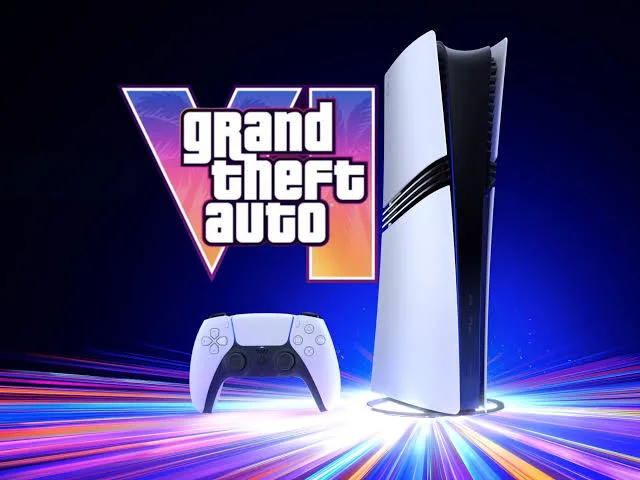
On November 19, Grand Theft Auto VI is set to arrive on consoles, bringing players’ 13-year wait to an end.
As before, GTA VI will launch on consoles first, while a PC release date has not been announced. Recent media reports, however, have claimed that Rockstar Games is considering a PC release in the first quarter of 2027. If that report is accurate, the game’s console-exclusive window would be less than six months.
That would be an unusual decision for Rockstar Games. GTA V arrived on PC about 19 months after its console release, while the PC version of Red Dead Redemption 2 followed its console launch by about a year. Go back another 24 years to 2002, and Grand Theft Auto: Vice City took about six and a half months to move from its PlayStation 2 debut to PC.
In other words, if the report is accurate, GTA VI could reach PC even faster than a game released 24 years earlier, breaking a release pattern Rockstar has maintained for more than two decades.
One important reason Rockstar has long favored console-first releases is that consoles generate far more revenue than PC. According to financial data from Rockstar Games leaked by hackers in April 2026, GTA V’s online mode, GTA Online, generated about USD 9.6 million per week on average. PlayStation and Xbox together accounted for about 97% of that revenue, while PC contributed only USD 264,000 per week on average, or less than 3%.
As the first mainline sequel in 13 years, GTA VI carries enormous commercial expectations for Rockstar Games. Given consoles’ dominant share of the company’s revenue, extending the new game’s console-exclusive period for as long as possible would seem to serve its commercial interests.
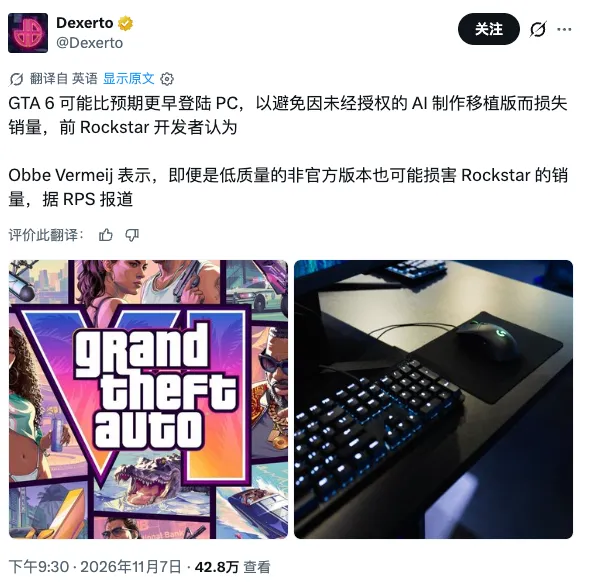
For this unusual release plan, former Rockstar technical director Obbe Vermeij has offered an explanation involving AI. He believes that advances in AI could lower the technical barriers to porting games across platforms. If the PC version of GTA VI is delayed for too long, some developers might use AI tools to create unofficial PC ports of the console version, potentially affecting sales when Rockstar later releases an official PC game.
Vermeij’s concern is not far-fetched; it reflects a challenge the game industry is already facing. As AI coding tools become more capable, developers have started using them to reverse-engineer and port games, allowing titles designed for consoles to run on phones and computers without official support.
You might ask, what is the big deal? Games have long been playable on phones and computers through emulators. But the situation has changed completely.
First, older games ran on phones through emulation, which translated their instructions inefficiently. Games could stutter, and devices often overheated. With AI-assisted work, games are now being ported natively to phones. That can make them far more efficient to run, so the heat and stuttering common with emulators are no longer the norm.
Second, the difficulty of porting games has fallen sharply.
For example, the creator of D2R Mobile ported the Nintendo Switch version of Diablo II: Resurrected to iPhone and Mac. The creator says that because the Switch, iPhone and Mac all use the ARM64 instruction set, most of the game’s code can run natively on iPhone and Mac after adaptation, while its graphics layer is routed through Apple’s Metal framework.
The game therefore runs as native software and performs well. The creator tested it at a stable 60 frames per second on an iPhone 14 Pro Max and newer models. Project initiator Joe Jiang says he has no technical background and that AI completed the port. The project came together after a month of nonstop work across five devices, using four Claude accounts with 20x usage and two Codex accounts.
That is an entirely different proposition from porting a game through human labor alone.
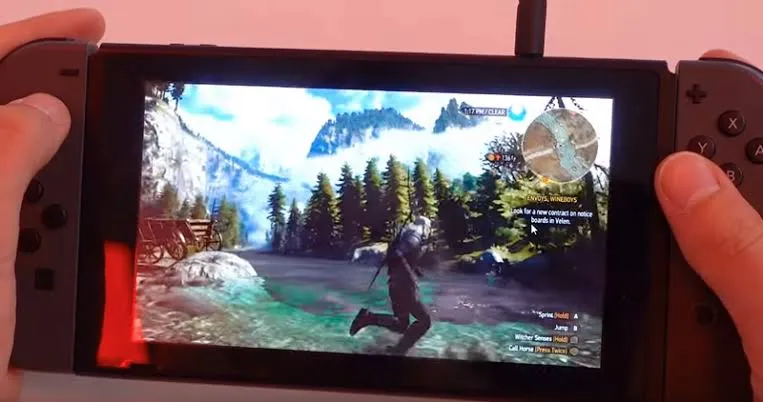
When the official team ported The Witcher 3 to the original Nintendo Switch, the work still took about 12 months, even with access to the game’s development files and a professional team. Independent developers without a team or the source files can take much longer. A Romanian developer spent five years porting Command & Conquer: Red Alert 2, a game many of us grew up with, to a web browser.
With AI, porting a Switch game to a phone has become remarkably simple. First, prepare a Switch game data package and connect the phone to a computer. Then give an agent tool the project’s GitHub page and ask it to follow the project instructions to build and install the game. We used Codex, and the whole process took about an hour and a half, including code adaptation, building and installation. The result was impressive: touch controls felt responsive, and the device showed no obvious overheating during extended play. If you have played emulator games on a phone, you will understand how difficult that used to be.
D2R Mobile is only the beginning. Project initiator Joe Jiang later released S2Arm, a general-purpose project for porting Switch games. According to data published by the project, the development team has tested 211 Switch games, with a 95% first-build success rate.
Other projects, including NX2Apple, nxnative and MacNativeGames, are using similar approaches to bring Switch games to native platforms. That means Switch exclusivity may no longer mean what it once did. Within hours of Nintendo’s newly released The Legend of Zelda: Ocarina of Time remake, for example, players were already sharing footage of it running smoothly on PC and phones.
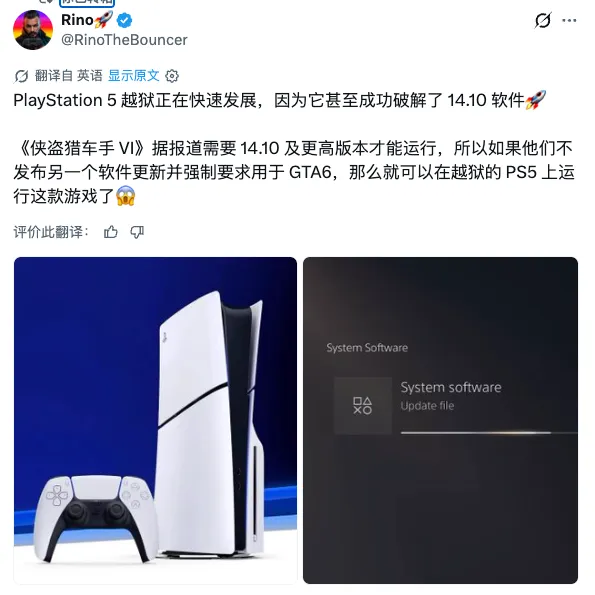
The Switch is not the only console platform being broken into. The PlayStation 5, where GTA VI is due to launch, faces the same challenge. The PS5 was previously jailbroken, and Sony released a new software version in response. A developer has since shown footage of that newer version being jailbroken again. It therefore seems nearly certain that after GTA VI arrives on PS5, it will be cracked and ported to consoles; the only question is how long it will take.
Take-Two, Rockstar’s parent company, has also responded to the piracy risks AI could bring. At its earnings call on November 9, CEO Strauss Zelnick said that game piracy had historically been limited by large file sizes, complicated cracking processes and features that require a connection to official servers. AI-assisted reverse engineering could make the problem more difficult. Take-Two is strengthening its technical defenses and preparing to use legal measures to protect its intellectual property. Zelnick, however, does not believe unofficial ports will pose a significant threat to the company’s financial performance. The experience itself is what matters, he said: even if developers can use AI to port a game, they may struggle to reproduce the experience Rockstar intends to deliver.
He was referring to the online services built around a game. More than 13 years after release, GTA V’s online mode still generates nearly USD 5 billion in annual revenue for Rockstar. The company clearly hopes to extend that business model to GTA VI.
In September, Twitch CEO Dan Clancy told Bloomberg that GTA VI’s online multiplayer mode is expected to launch in 2027. In his view, the game could attract even more attention once multiplayer goes live.
For GTA, the online mode has helped build a deep moat around the game itself. For the broader market of single-player console games, however, AI-assisted ports are a more immediate threat, and the industry is beginning to confront that shift.
On October 13, Xbox CEO Asha Sharma said in a public statement that AI-assisted reverse engineering is challenging the game industry’s longstanding assumptions about the link between software and hardware. She said that even if these changes could disrupt existing business models, it is worth exploring ways to let more players access games and give old titles new life. Xbox has therefore established Xbox Labs, a team of game developers, engineers and scientists studying technologies for cross-platform play, content modification and player creation.
Not everyone is so optimistic.
Luke Dicken, Take-Two’s former head of AI, told Kotaku that AI-driven game decompilation and unofficial ports have become issues developers and publishers must take seriously. As these tools spread, he believes companies may strengthen digital rights management (DRM), impose tighter platform restrictions or turn to cloud gaming to prevent players from accessing game files directly.
Cloud gaming is also supported by Stephen Kick, head of Nightdive Studios. As someone involved in many classic-game remakes, he offered an even more radical view: if AI helps developers reverse-engineer games quickly, publishers may eventually stop giving consumers complete local game files and switch to cloud streaming to reduce the risk of game code being extracted and reverse-engineered.
Previously, Sony stopped releasing physical editions of games to promote digital sales and expand revenue, sparking debate among players about game ownership. If publishers really turn to cloud gaming to guard against AI reverse engineering, the player community could be set for another fierce backlash.