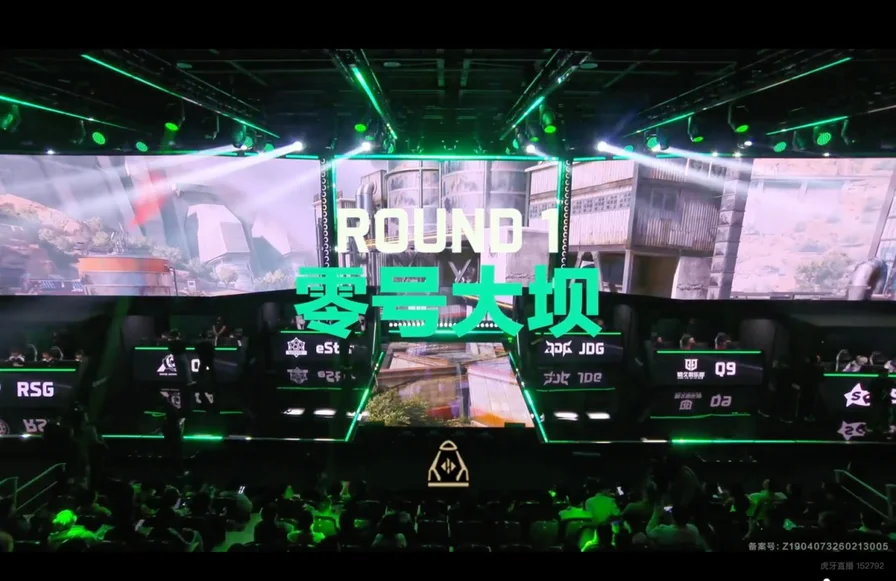
On March 25, Beijing Smart Media Innovation Center hosted the opening day of the 2026 Delta Force Fire Professional League Spring regular-season group stage. The Group A match between Q9 and SYG was also the opening match of the entire league.
By the seventh game, the group had still not decided which teams would be eliminated. SYG and Q9, the 2025 Delta Force Fire World Cup champions, were both at risk. With 20 seconds left as SYG began decoding its first MandelBrick, Q9 made a decisive attack. The miracle did not continue: three Q9 players were defeated, while SYG successfully completed the decode.
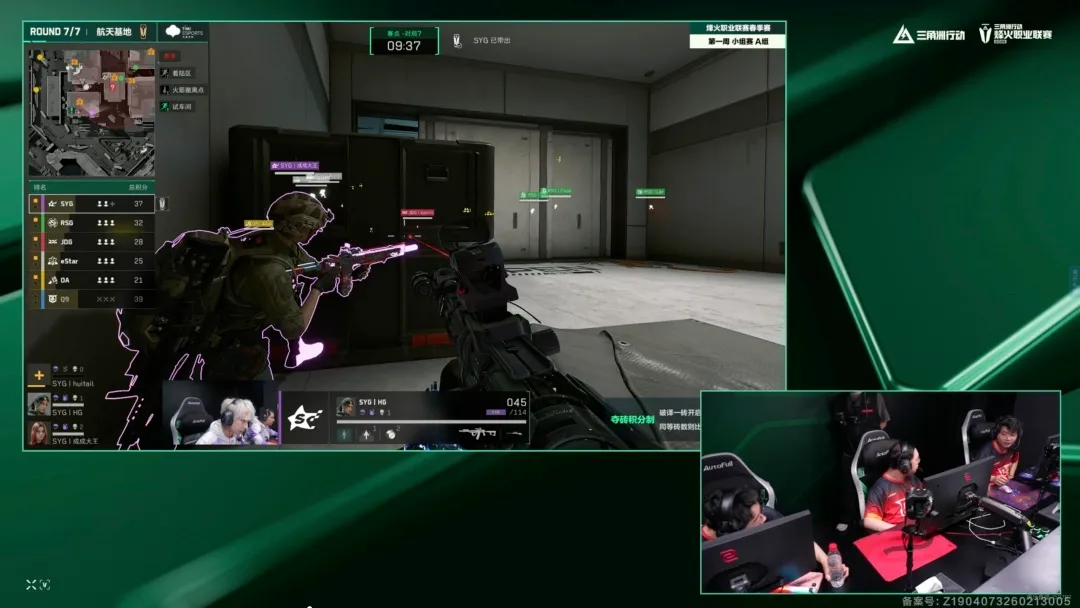
Q9 became the first team eliminated from the group stage on opening day.
The world champion Q9 became the first team eliminated on opening day and missed the rest of the week’s matches. That was the intensity of the Fire Professional League. The fierce competition excited the players on stage and surprised the audience.
The surprise came from the assumptions surrounding “search, fight, extract” esports. On the opening day, however, the addition of the “capture-the-brick scoring system” raised the level of combat. SYG, which finished first in Group A, recorded 26 eliminations in its opening match. Even Q9, which was eliminated, recorded 15. The amount of fighting changed the audience’s understanding of the format. Every important elimination brought cheers from the venue and flooded the online comment feeds.
Because of the quality of the competition, the first day of the Delta Force Fire Professional League Spring season reached the top of the hot-search rankings on Bilibili and Douyin. Its early performance gave audiences reason to expect more from Delta Force’s new professional league.
Making “Search, Fight, Extract” Professional Esports
For a long time, “search, fight, extract” has been a demanding subgenre within shooter games. Its complicated resource-gathering and extraction systems create significant strategic depth, but turning that depth into a professional esports product with strong viewing appeal and competitive fairness has been a challenge for the industry. In earlier competitions, the team that attacked first could easily become the weaker side. Many teams therefore chose to hold angles and wait, and players described many matches as “mutual camping cups.” The matches did not start fights, and that was not compelling for viewers. Such a situation is obviously unacceptable for an esports competition.
At the same time, if players only fight throughout a “search, fight, extract” match, the result no longer reflects the core of the game. How to change the rules so that a reasonable proportion of “search, fight, extract” content appears on stage has therefore become an urgent problem for this form of esports. On the opening day of the Delta Force Fire Professional League, we saw how the organizers understood the task of turning the category into an esport.
First, as in last year’s Fire Cup, victory still revolves around the MandelBrick. The difference is the addition of the “capture-the-brick scoring system,” which allows suspense to continue throughout a match. Decoding one MandelBrick only opens the match point; decoding two wins outright. When several teams have decoded one MandelBrick each, their ranking is decided by squad points from eliminations and resource conversion. Eliminations therefore become a source of points at settlement. This increases the value of fighting during a match and allows the rules to reward the team that wins the most fights.
SYG’s comeback from the bottom of Group A to first place was the clearest illustration of the system. At the end of Game 6, it was last in the group standings. In Game 7, it first decoded a MandelBrick to open the match point, then used eliminations and extraction points from the game, together with its accumulated points, to overturn the table and take first place.
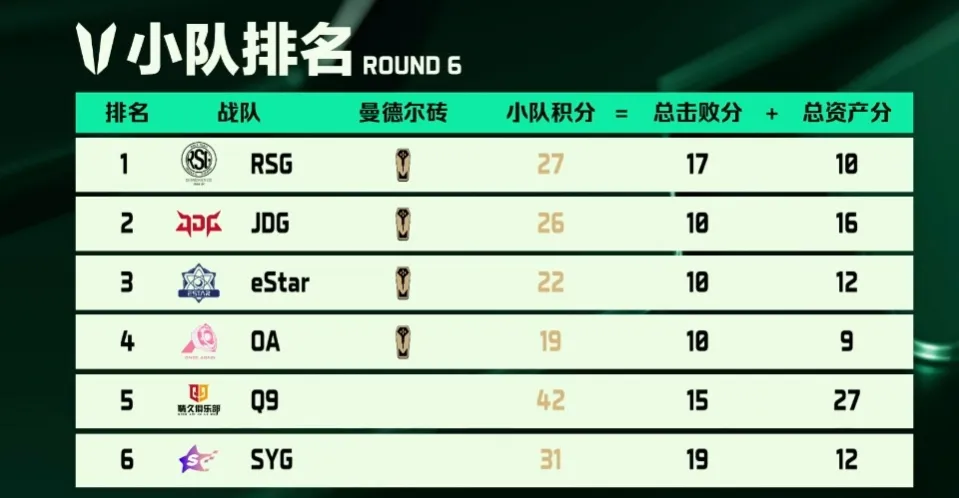
SYG was last in Group A after Game 6.
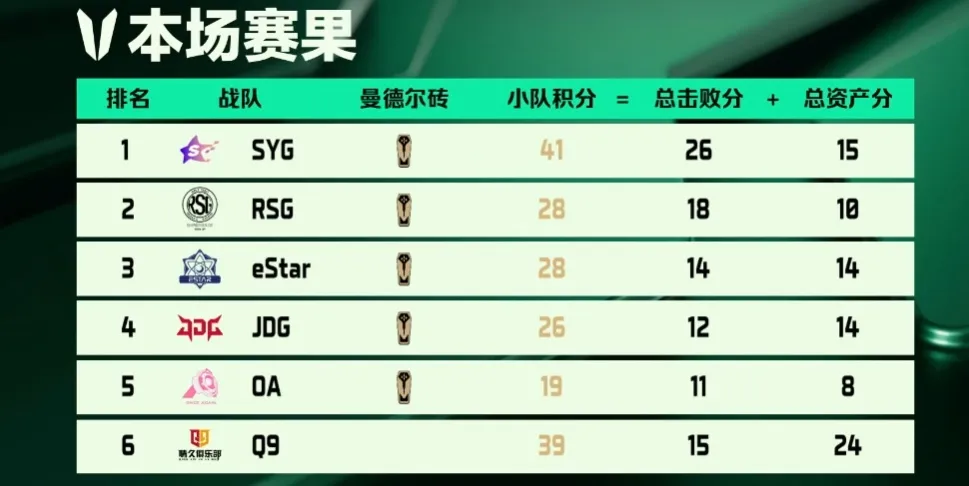
SYG completed its comeback to take first place in Group A.
This format exploration has, to some extent, made the so-called “mutual camping cup” a thing of the past. On the opening day, rules encouraged players to keep fighting and produce a series of exciting eliminations. The result showed what it means to keep shooting, keep bringing loot home and extract quickly.
The professional league also increased the number of games from the six used in last year’s Fire Cup to seven. Although the change is only one game, it reduces the impact of randomness in any single game at the strategic level. Before Games 3 and 7, the lowest-ranked squads can choose the map, giving them more room to adjust tactically and fight back from a disadvantage. The map pool also added Tide Prison, a map that has been strongly requested by players.
This attention to the underlying rules reflects Delta Force’s focus on the competitive standards of the “search, fight, extract” category. It is difficult to say whether the league’s rules are optimal, but they show the organizers’ determination and attitude in taking on the difficult task of professionalizing the category.
The map pool now includes Tide Prison, a location strongly requested by players. These changes are small on paper, but they show where the organizers believe professional extraction esports will be won: in the underlying incentives, not only in broadcast presentation.

The league’s format is built around the MandelBrick objective and accumulated squad points.
The importance Delta Force places on esports is also reflected in the participation of top organizations such as AG Delta Force, Bilibili Gaming Delta Force, JD Gaming Delta Force and Weibo Gaming Delta Force. These established esports clubs are not joining only to compete for a spring title. They are also betting on the commercial value and ecosystem potential of “search, fight, extract.”
The category has attracted attention beyond clubs. The same is true of established professional players. Team WE Delta Force player MingYue previously appeared on the world stage in another title under the ID “Wugeng Mingyue.” His passion for esports did not disappear when he retired from that title; instead, it brought him to Delta Force.
At the 2025 Delta Force Fire Cup, the MDYW team he led finished third. That result did not satisfy him. He chose to continue his professional career in Delta Force, and when he returned to the stage he was already a WE player. After finding his professional passion again, he declared in an official video: “I will crush the whole league!”
The participation of star clubs and the recognition of professional players will not only raise the league’s brand influence, but also increase its visibility among esports fans. It can help Delta Force develop a benchmark for competitive events in the “search, fight, extract” category.
From Gameplay Development to League Iteration
Solving the gameplay question of whether the category can be played competitively is not enough. A mature professional league needs a complete ecosystem foundation.
After establishing competitive standards at the gameplay level, Delta Force has undertaken a broad exploration of the competition format and league ecosystem.
To maintain the competition’s vitality and keep viewers engaged, the first five weeks of the spring regular season will feature 10 matches each week, with teams eliminated every day. After the top 16 teams in the regular-season standings enter the playoffs, they will face a brutal round-robin-style competition, with only six teams advancing to the final. This format increases the value of qualifying and allows viewers to experience the distinct appeal of “search, fight, extract” esports through frequent, high-intensity competition.
The league’s entry mechanism is equally deliberate. The spring season has 24 teams, divided into 18 fixed teams and six temporary places. This system supports the long-term development of clubs while leaving room for new teams to enter, making it one of the core forces behind the vitality of Delta Force esports.
The six temporary-place teams are not to be underestimated. In a video where professional league players ranked all the teams, WBG’s Haojie pre-ranked the temporary-place team TE as “solid.” His reason was that it had come through the temporary-place selection, which was also quite brutal: if a team made it through, it certainly had something.
RSG, which was ranked “still to be observed,” performed impressively on opening day and became the first team to secure a place in the upper-bracket qualification stage as Group A’s runner-up. Even professional players can misread an opponent, showing just how intense and unpredictable the Fire Professional League can be.
After only the opening day, the league had already produced consecutive upsets. The world champion Q9 was eliminated, while RSG, which had not been highly regarded before the competition, became Group A’s second-place team. The sharp contrast between the results and pre-match expectations confirmed the excitement of the league and created more suspense for the matches ahead.
To further encourage temporary-place teams and activate competitive energy, the organizers are offering them a path to a summer-season main-stage place. Any temporary-place team that reaches the spring final will qualify directly for the summer main stage. This promotion route adds another point of interest to the ecosystem and gives players pursuing a professional future a new possibility.
The commercial ecosystem also benefits from the existence of 18 fixed teams. Those places give strong teams soil in which to develop over the long term and allow club brands to grow alongside the league. That can further complete the competition’s commercial value loop and create the conditions for cooperation and shared growth.
A Spring Season as a Window onto the Global Esports Map
The spring season that opened in Beijing is not a small, niche celebration. It carries Delta Force’s ambition for esports.
Through careful competition planning, Delta Force has built an ecosystem spanning mass competition, professional competition and a world championship. When professional teams fight over every point on the spring-season stage, they are looking toward the opportunity to reach the World Cup.
Spring-season points are crucial in this ecosystem. Points accumulated across spring and summer will directly determine qualification for the 2026 Fire World Cup. From a domestic competition to a global tournament, Delta Force has laid out a “global, all-mode, all-pathway” esports map in little more than a year.
From an industry perspective, a high-level professional competition is the foundation of Delta Force’s move toward long-term operation. With more than 50 million daily active users, a complete league system becomes an important anchor for converting player enthusiasm and extending the game’s vitality.
The coordination between the player base and the esports ecosystem can raise the brand’s global influence. By integrating leading industry resources, it can also create a meaningful competitive advantage and inject lasting energy into long-term operation and gameplay iteration.
Epilogue
March 25 may have been an ordinary Wednesday for most people. For “search, fight, extract” esports, it was a solid starting point.
After watching the Fire World Cup final and the Full Battlefield International Invitational last year, many players began thinking about how a professional competition system for “search, fight, extract” would be built. The Delta Force Fire Professional League Spring season has not only answered that question; it has also completed an ecosystem connecting mass competition, professional competition and international competition.
That makes us look forward to the value Delta Force, a game that has innovated at the gameplay level, can create on the professional esports stage.