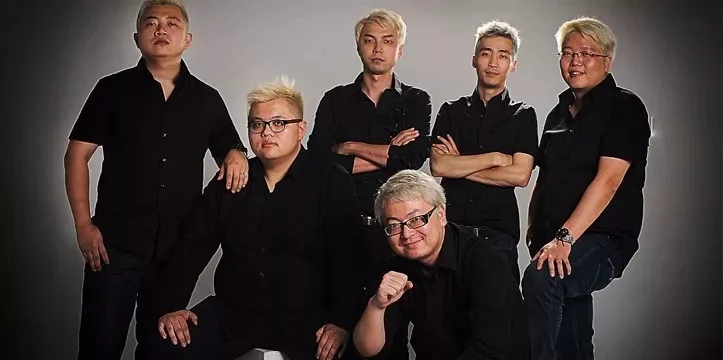
Six people left their former employer at different times, then set out on their own to found ImbaTV. They went from early inexperience to hard-won maturity. Who knows what the six of them went through along the way?
There was an internet-era joke about the would-be entrepreneur: you use a Xiaomi phone, wear a Vancl T-shirt, drink Beita coffee at startup lectures, watch Yale open courses at home, follow Zhihu and Guokr, read 36Kr every day, know the big picture at BAT and can recite every detail of WeChat founder Zhang Xiaolong’s “greed, anger and delusion.” You eat roujiamo only at Xishaoye, arrange dinners at Diaoye, like Luo Yonghao more than Steve Jobs, and talk about “internet thinking” to everyone you meet. If all of that fits, you are probably still crammed onto the subway every day.
That was a familiar portrait of an aspiring internet entrepreneur, but it was far removed from the reality facing esports founders. As the internet startup wave swept the world, esports was still treated as barren ground. Even some of the scene’s insiders had only recently begun to attract the attention of capital.
Against those relatively primitive conditions, “117” Shen Weirong, “Yaomo” Zhang Zhexi, “83” Wu Zhongyu, “Pony” Liang Ruobing, “Haitao” Zhou Lingxiang and “BBC” Zhang Hongsheng set out to build a company together around 2014. They founded ImbaTV, but they were not yet comfortable with the flood of “mass entrepreneurship” or the language of “internet thinking.” They were still green when it came to capital.
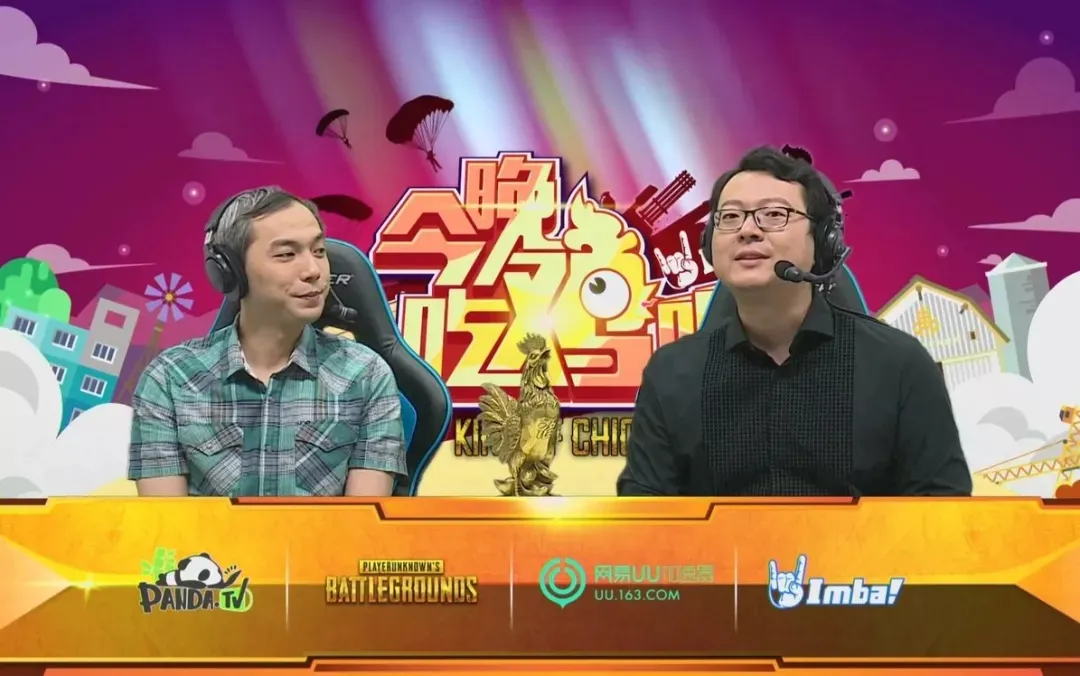
Two esports presenters during an ImbaTV program.
“Things Are About to Change”
“It’s time to get out.” In the autumn of 2013, while still working at Gamefy, Shen Weirong approached his close friend Zhang Zhexi, known as “Yaomo,” and said he wanted to find a few friends and go it alone.
“But have you thought about what the two of us would do if we started a company?” Zhang asked, in response to Shen’s still-unformed ideas.
“With the resources we’d built up, we could even open an advertising agency and there’d be enough for a few brothers to split.” At first, Shen had no detailed plan for the business. He and Zhang were earning only a few thousand yuan a month. “Whatever we did, it should be better than earning a few thousand a month.”
That was the simplest answer Shen could give Zhang on paper. After years working together at Gamefy, though, the two sensed that esports broadcasting was about to change. That was the real reason Shen wanted to set out on his own. “I just had that feeling. It was hard to put into words. One thing was that the whole industry was going to change; the other was the reality of our income.”
Around 2012, Zhang encountered Justin.tv, the company behind Twitch, while overseas and had an opportunity to buy the service. After returning to China, he spoke with Shen, and the two decided that acquiring Twitch would be excellent value for money. Shen thought the idea was “solid” and tried hard to persuade the company’s senior management. At the time, the price was just over RMB 3 million.
Shen and Zhang believed that conventional broadcast television did not represent the younger generation. Internet distribution was the format young people preferred, and young people were esports’ core audience.
The two men’s enthusiasm did not win the day. Management repeatedly told them to “evaluate it” and “write a report,” until the process ended with the verdict that the price was too high. The irony, the article observed, was that Twitch surpassed 40 million monthly active users in early 2014 and was acquired by Amazon for US$970 million that August.
“The world outside was changing rapidly, while where I was still clung to old ways,” Shen recalled. Around 2013, the idea that internet television would replace conventional TV was a popular topic. LeTV, led by Jia Yueting, rose during that wave. Although LeTV was then under heavy public scrutiny, its experiments and theories about internet television continued to influence people in the industry.
The industry’s direction did turn out as Shen had sensed. DouYu was established in 2014, while Huya Live became independent from YY that same year. The two leading game livestreaming companies helped shift esports distribution from traditional broadcast signals to the internet, a change that also accelerated the growth of the wider esports industry.
Looking back, the article describes Shen and his partners’ move as an act of following the industry’s direction. They had not deeply studied the internet’s trajectory; years of work in esports simply helped them choose change at a decisive moment.
Esports Partners
At first, Shen told only Zhang Zhexi about his idea to start a company. The other core members did not know. After Shen had handled some of the transition work, “83” Wu Zhongyu, “Pony” Liang Ruobing, “Haitao” Zhou Lingxiang and “BBC” Zhang Hongsheng gradually learned that he planned to leave.
At one farewell dinner after another, Shen’s founding group grew. “It’s kind of funny. Almost every time I went to say goodbye, a few more friends wanted to join.”
Shen, Zhang, Wu, Liang, Zhou and Zhang became the company’s core team. Their original plan was a traditional one: “put in money and put in work.” “At first, it was just a few brothers putting in some money to start a company, then dividing things up according to how much each person contributed.”
The six had not considered fundraising. Zhang Hongsheng put it plainly: “It was like opening a restaurant with friends.”
But Zhang still had commentary and other program work at Gamefy, so he could not join the company’s day-to-day operations immediately. The others waited several months for him. “They were busy with the company. I had to finish handing over my old job before I could come out.”
Shen initially made a routine post on Weibo saying that he was starting a business, without naming the core team. Only after all six were free of their former jobs did they formally announce they would “do something together.”
Their planned business was straightforward: use game content as an entry point and supply programming to livestreaming platforms such as YY and DouYu. The six believed that platforms were fighting fiercely for users and that content was the scarcest resource in the contest.
“We wanted to try different ways of presenting things, adjust the content based on user feedback, make room for trial and error, and create something with ImbaTV’s own style,” Zhang Zhexi said. They imagined developing more specialized esports programming: player interviews, documentaries about competitions, repackaged match content and highlights, as well as game tutorials.
Promotional artwork for “Tidehunter and Shadow Fiend Matchup,” a Dota 2 program.
The six had settled on the company’s direction and began submitting their resignations to their former employer.
Not long after Shen announced that he was starting a company, investors began paying attention. Twitch had been revalued by capital, and a “sky-high” transaction seemed only a matter of time. Investing early in companies across China’s esports value chain looked like a way to position ahead of that change.
At first, only Innovation Works showed interest in Shen and his team. Sequoia Capital followed later for the Series A. “We didn’t understand much at the beginning. We just looked at the other side’s credentials. ‘Wow, this one has money; that one has a lot of strength.’ It really opened our eyes,” said Shen and Zhang, who were handling fundraising.
During the Series A, Shen and Zhang met dozens of investment firms. They learned through repeated conversations with investors and funds. “We met so many because we didn’t really understand it yet. We couldn’t tell who had real strength and who was bluffing.”
After more than a month of meetings and discussion, Shen told the other five: “Let’s take Innovation Works’ money first.” Before he could fully explain his reasoning, he heard the other five unanimously agree. “They invested several million dollars. At the time, it felt like such a huge amount of money. We thought, ‘So we’re worth that much?’” Zhang Hongsheng said.
Their inexperience was understandable. No esports company had yet attracted major investors such as Innovation Works or Sequoia. “We wouldn’t think that way now. Looking back, we were pretty green.”
The investors, however, had not all accepted the decision. Sequoia wanted to join the Series A. Cao Xi went to ImbaTV’s office and played Pro Evolution Soccer with the core team. With the 2014 World Cup in Brazil approaching, they used the game to talk about products and the esports industry, and discovered common ground.
For ImbaTV, Sequoia’s participation could bring industry resources to help the company grow. The article noted that around the time Sequoia invested in ImbaTV, Cao also backed DouYu, Hero Entertainment, Dongqiudi, Wanhe Tianyi and Aixianfeng for Sequoia; DouYu and Hero Entertainment could create business synergies with ImbaTV.
“Yaomo and I were actually nervous when we told Innovation Works about Sequoia. We thought they might resist, but they didn’t mind. They thought having Sequoia was even better,” Shen said. As a “rookie CEO” managing a financing for the first time, he had assumed that a co-investor might upset the lead investor.
From 117 to Shen Weirong
Before founding ImbaTV, Shen was known mostly as “117,” his professional esports player ID.
He took pride in his time as a professional player. The name 117 had become part of him, and he kept using it in his work after retiring.
Before he chose to start a company, the public still knew Shen as “117.” Few people outside the esports industry knew his real name. The same was true of Zhang Hongsheng, Zhang Zhexi, Wu Zhongyu, Liang Ruobing and Zhou Lingxiang: before ImbaTV existed, they were known by handles such as BBC, Yaomo and Haitao.
As Shen entered the startup world, he used his real name more often. He now had to deal with investors, media, and senior figures at game companies, not only longtime esports insiders.
“Compared with me, since I don’t go out much, 117 changed a lot personally as the CEO,” Zhang Hongsheng said of the changes Shen made for the company. He did not quite break into tears, the article observed, but it was clear that the six had been through a difficult journey together.
“After starting the business, what I looked forward to most each year was having a few quiet days over the New Year holiday—chatting with relatives and playing mahjong,” Zhang Hongsheng said. The workload after starting a company was several times heavier than before, and he had to think about things he had never imagined.
After the Series A experience, Shen realized the company could not be run like a small workshop. When he signed investment agreements with his name, the era of simply making sure a few friends had enough to eat was over. Behind him stood a company with more than a hundred employees.
By the time Series B arrived, Shen and Zhang, the two partners primarily responsible for fundraising, were more composed. They no longer had to respond substantively to every investment firm that approached them, as they had during Series A. The venture capital world had its share of people who talked big, and there was no need to waste time with them.
After a period of contact and review, ImbaTV announced in October 2015 that it had completed a Series B financing of about RMB 100 million. Zijin Culture Fund, under Yida Capital, led the round; Pusi Capital participated, and Series A investors Sequoia Capital and Innovation Works also followed on.
“Series B was much easier. At least we no longer had to spend so much time teaching investors the basics of esports. The people who wanted to invest in us understood the industry,” Shen recalled. During the Series A, many investors were interested in esports but had little understanding of it. They habitually treated esports as just another branch of online gaming. Whenever they had an opportunity, the six repeatedly explained the basics. “Even now, some investors still think that way.”
The article says that bringing in Pusi Capital, owned by Wang Sicong, during Series B reflected Pusi’s strong understanding of the esports industry. The two sides were a good fit.
Old-School Esports People
“At the end of the day, we’re all fairly old-school esports people. We couldn’t really accept that kind of mobile esports,” Shen said. A planned investment by Hero Entertainment eventually fell through because of differences in their ideas.
Less than six months after ImbaTV announced its Series B, Hero Entertainment’s industry investment fund said it would invest in the company. It also said ImbaTV’s Chinese name would become Hero Media after the investment, and the two sides would cooperate in mobile esports tournaments, mobile game operations and game promotion.
But the ImbaTV six saw esports as competition driven primarily by human skill: intense contests, impressive execution and creative tactics that could surprise audiences. Luck could play some role, but every player had to begin on a fair and equal footing.
When some mobile games tried to launch esports businesses, the founders felt those products were far from their own ideas. “It’s difficult for these games to show enough competitiveness directly, and most of them don’t have long life cycles. They wouldn’t give us enough time to develop quality content,” Shen said.
“Purely in theory, if a PC can support esports, a phone should be able to as well. But actual operations are different. We’re making something related to sports competition,” Shen said. He compared the logic to Chinese films at the time: “Aren’t those so-called fan films just arithmetic—adding together the fanbases of a few IPs because, logically, you think that makes a movie? They ignore the core of a cultural product.”
When the six first encountered Hero Entertainment’s mobile esports concept, they were excited. They had planned mobile esports on the strength of pure logic, but hands-on experience showed them that they had to return to the fundamentals of operating esports. After a brief period of enthusiasm, they discussed it together and realized it was not what they wanted to pursue.
Although they felt they were letting Hero Entertainment down, Shen represented the company in declining the offer, guided by the founders’ genuine preferences and long-held principles.
The transaction fell apart before ImbaTV could change its name to Hero Media. The six, who had thought Hero Entertainment might help them capture the high ground in mobile esports, returned to running the company as before. They refocused on their own third-party tournaments. Their i-League was expanding internationally, with ImbaTV events taking place in Ukraine and Los Angeles.
“If I really had to go to the venue, I’d have to grit my teeth and fly. I’m actually afraid of flying,” Zhang Hongsheng said. In the past, even when travelling to the Northeast or Northwest for events and business, he insisted on taking trains for more than ten hours and transferring along the way. “So going to TI was torture for me. It took more than ten hours to fly to the United States.” To get through a flight, he would watch several films about air disasters beforehand to steel himself. “After watching enough, I became numb to it, and then I wasn’t so afraid.”
Perhaps an investment from Hero Entertainment would have spared the six some of that hardship. While ImbaTV was grinding away in PC esports, Hero Entertainment—whose investment they had once considered—was making moves in the capital markets. In February that year, Hero Entertainment announced that it had signed an A-share listing services agreement with Guotai Junan Securities.
The fabled capital exit seemed close to the six, yet they had missed it because they held to certain principles. “Everyone has their own life. We’re content if we can do the things in front of us well,” Shen said. Almost as Hero Entertainment announced its plan to pursue an A-share listing, ImbaTV announced on its official Weibo account that it had completed a Series C round. Fortune Capital led the round, with Suzhou Guofa and Yida Capital participating.